
How to Read a Nutrition Label (And Actually Use It)

How to Read a Nutrition Label (And Actually Use It)
Most people glance at the calorie count and move on. That's leaving a lot of useful information on the table.
A nutrition label is a compact snapshot of exactly what you're putting in your body. Once you know what each section means, scanning a label takes about ten seconds - and it can meaningfully change what ends up in your cart.
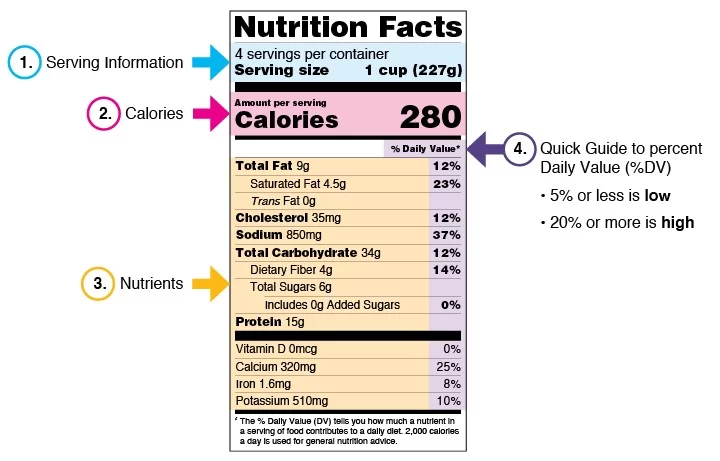
There are four key sections to understand: serving size, calories, nutrients, and the daily value (DV) percentage column. Here's what each one tells you and why it matters.
Start With Serving Size - Everything Else Depends on It
The serving size sits at the top of the label for a reason. Every number below it - calories, fat, sodium, all of it - applies to that one serving, not the whole package.
Take a box of mac and cheese with 4 servings at 280 calories each. If you eat the whole box, you've consumed 1,120 calories. That's more than half a standard 2,000-calorie daily intake in a single meal. The package doesn't hide this - it just requires you to do a small amount of math.
Paying attention to serving size is probably the single most practical thing you can do to get accurate information from a label.
Calories Tell You the Energy Cost
Once you know the serving size, the calorie count tells you the energy cost of eating that amount. This is useful whether you're tracking calories intentionally or just trying to stay roughly aware of what you're eating.
If your daily calorie target is different from the standard 2,000 - which it likely is - keep in mind that all the label's math is built around that 2,000-calorie baseline. People on a weight loss plan often use a rough formula based on goal body weight:
- Sedentary: Goal weight × 5 = daily calorie target
- Moderately active: Goal weight × 6 = daily calorie target
- Very active: Goal weight × 7 = daily calorie target
These are general estimates, not medical prescriptions. Your actual needs depend on factors like age, health status, and metabolism. But as a quick field calculation, it's a reasonable starting point.
Nutrients: What You're Getting Beyond the Calories
Below the calorie count, you'll find a breakdown of individual nutrients: total fat (and fat subtypes), cholesterol, sodium, carbohydrates (including fiber and sugar), and protein.
A few things worth noting:
Fat: Fat contains more calories per gram than protein or carbohydrates, so it adds up faster. The label breaks fat down into subtypes. Saturated fat is the main one to watch - the American Heart Association suggests keeping it under 13g per day on a 2,000-calorie diet. Trans fat, when listed, is worth avoiding altogether; it raises LDL (bad) cholesterol and is associated with increased risk of heart disease, stroke, and type 2 diabetes. Many manufactured trans fats have been phased out of the U.S. food supply, but it's worth checking.
Sodium: Essential for fluid balance and nerve function, but easy to overconsume in packaged foods. High sodium intake is linked to hypertension and elevated blood pressure.
Everything else: Cholesterol, carbohydrates, fiber, sugar, and protein all matter in different ways depending on your health goals and any conditions you're managing. There's no universal "right amount" - it depends on the individual.
Daily Value Percentages: A Quick Benchmark
The %DV column on the right side of the label is calculated against a 2,000-calorie diet. It gives you a fast way to gauge whether a food is high or low in a given nutrient.
The general rule: 5% DV or less is low. 20% DV or more is high.
Use this as a directional guide, not a rigid rule. If one serving of a food contains 33% of your daily sodium, that's worth noticing - especially if you'll be eating sodium from other sources throughout the day.
In general, you want to see higher %DV for things like dietary fiber, vitamin D, calcium, iron, and potassium. You want to see lower %DV for saturated fat, sodium, and added sugars.
If your daily calorie intake is significantly below 2,000, the percentages on the label will understate the proportion of your daily needs that a single serving covers. Just something to keep in mind.
The Simple Version
Nutrition labels aren't complicated once you know what to look at. Start with serving size - it anchors everything else. Check the calories to understand the energy cost. Scan the nutrient list for fat type, sodium, and anything relevant to your health goals. And use the %DV column as a quick high/low reference.
You don't need to analyze every number every time. But knowing how to read the label gives you real information to work with instead of guessing. That's worth the ten seconds it takes.
Need Urgent Care today?
We’re here to help — fast, affordable, and straightforward.